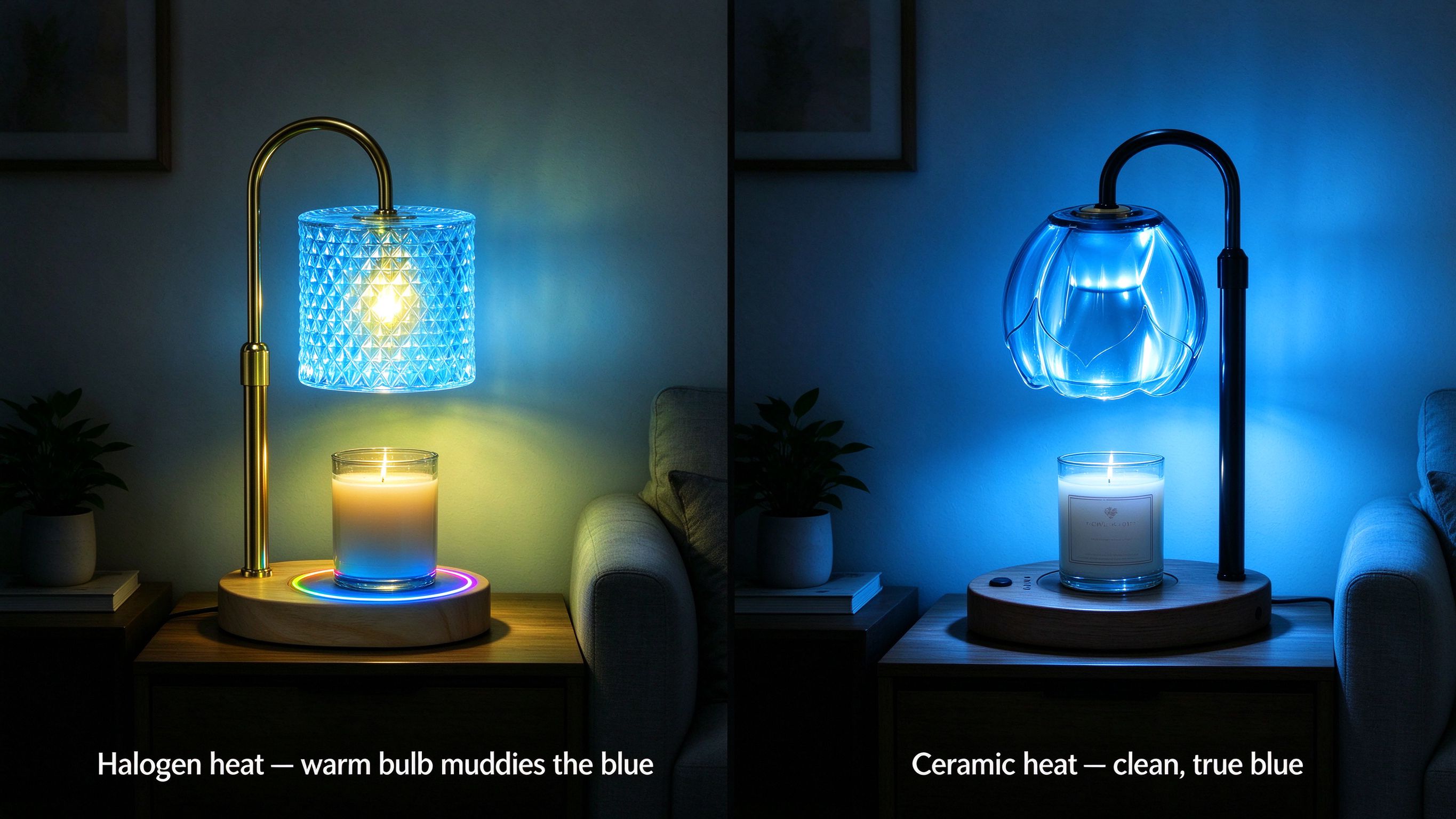
Two shapes, one job
Every candle warmer does the same core thing: warm the wax so fragrance releases without lighting the wick. The market has settled into two shapes for doing it, and the difference comes down to exactly where the heat enters the candle.
A hot plate is a shallow heated base. The jar sits directly on top of it, and warmth climbs through the glass from below.
A lamp warmer holds its heat source above the candle, the way a desk lamp holds a bulb. Warmth points down, and the melt pool forms at the top of the wax.
Both share the flameless basics — no soot, no smoke, no open flame — and both beat a lit wick on the quiet questions. We covered those trade-offs in detail in whether a candle warmer is safer than burning candles. What the two shapes do differently is how the candle itself experiences the heat, and that is what should decide which one you buy.
What happens to the wax
On a plate: the bottom first
A plate's hottest point is the glass at its center, so the wax at the bottom of the jar melts first and the melt climbs as the session continues. More wax is liquid at any given moment, which has two visible consequences.
The first is scent: a bigger melt pool means the fragrance arrives sooner and hits harder at the start of a session. The second is consumption: a candle heated from the bottom up gives up more of itself per evening than one warmed gently at the top. If you go through jar candles quickly and like a strong first impression, that is the plate doing exactly what its design intends.
Under a lamp: the top first
A lamp melts the top layer edge to edge — the same even pool a good first burn would form, minus the flame. The wax below stays firm, so each session consumes a thinner slice of the candle. Less wax liquefied per evening means the candle lasts longer, and nothing gets wasted down the jar walls.
The trade is patience. A top-down pool takes longer to reach full fragrance than a heated base does. Scent builds gradually across the session instead of arriving all at once — closer to how a candle behaves when it is lit, rather than how a wax melt behaves.
The jar and the surface beneath it
This is the difference people notice with their hands first.
On a plate, the jar is the thing being heated. The glass at the bottom becomes hot enough that moving the candle mid-session is a two-cloth job, and the surface underneath — a wooden shelf, a fabric runner, a low bookcase — needs to tolerate a warm base sitting on it. Homes with small children or curious pets need to treat the whole jar as a hot object, because that is what it is.
Under a lamp, the warm spot is at the top of the jar and the base stays comparatively cool. The candle can usually be nudged or moved well before the timer ends. The lamp head itself is the hot part, and it is above eye level for a crawling toddler rather than at plate-height on a table.
None of this makes either design unsafe — both are flameless appliances running at wax-melting, not cooktop, temperatures. It is a difference in where the heat lives and who in the household can reach it.
The maintenance question
Here the two shapes split again, and it is the quietest buying mistake in the category.
A plate has nothing to maintain. The heating element is sealed inside the base, there are no parts rated to fail, and the device either works or does not.
A traditional lamp runs on a halogen bulb, and the bulb is a consumable. It burns out, replacement is a matching exercise, and the failure tends to arrive mid-season — exactly when the warmer is needed. That failure mode is common enough that we wrote an entire guide on why halogen bulbs in candle warmers burn out so fast.
There is a third path: a ceramic lamp. It keeps the overhead shape but swaps the bulb for a ceramic heating element — heat without light, and no consumable in the chain. Our Color-Changing Candle Warmer works this way: the ceramic element does the warming, separate LEDs do the lighting, and neither one can burn out and take the whole appliance with it.
The light
Plates are dark. Your room keeps whatever lighting it already had, which some people prefer and others experience as a missed opportunity — a warm pool of wax with nothing to show for it.
Halogen lamps glow. The bulb that heats the wax also casts a warm yellow light, and that yellow mixes with everything near it, including a colored shade. It is a real effect, visible in the comparison photo above: the same blue shade reads warm and muddy over a halogen bulb and clean over a ceramic element.
That is why the light question matters more than it sounds. On our warmer the light is a separate system — seven colors with breathing and gradient modes, brightness from 25% to 100% with press-and-hold dimming, all controllable from the included remote. Because the ceramic element gives off no glow of its own, the color you pick is the color the room gets.
The comparison table
| Question | Hot plate | Halogen lamp | Ceramic lamp |
|---|---|---|---|
| Where heat enters | The jar's bottom | The wax's top | The wax's top |
| Where wax melts first | The bottom | The top | The top |
| Scent at the start | Arrives sooner | Builds gradually | Builds gradually |
| The jar's base during use | Hot | Cool | Cool |
| Consumables | None | The bulb | None |
| Light added to the room | None | Warm yellow glow | The color you choose |
| What eventually fails | Rarely anything | The bulb | Rarely anything |
Which one fits you
- You want the room scented fast, and candles are consumables anyway. A hot plate gives the quickest, strongest throw and asks nothing of you but a heat-tolerant surface.
- You have jar candles you actually like and want them to last. A lamp's top-down melt uses less of the candle per session and keeps the base cool.
- You like the lamp idea but not the bulb subscription. A ceramic lamp is the overhead design with the consumable removed — and on ours, the light is a feature instead of a side effect.
Whichever shape you choose, the flameless core is the same: the wick never lights, the air stays clear of soot, and the candle releases fragrance the way it was scented to. The two designs are not competing philosophies of safety — only of heat.
If the third column is the one that matches your room, the Color-Changing Candle Warmer page has the full specification: heat levels with an Auto program, a 2, 4, or 8 hour timer, the remote, and the seven-color light.
FAQ
Is a candle warmer lamp better than a hot plate?
Neither wins outright. A plate throws scent sooner because more wax melts at once; a lamp is easier on the candle, keeps the jar base cool, and adds light. Pick by which trade you would rather live with.
Do hot plate warmers melt the whole candle?
A plate heats the jar from below, so a larger share of the candle melts during each session — the bottom of the jar, not just the top. How far up the melt climbs depends on how long you let it run.
Which type makes the candle last longer?
Top melting. Warming only the top layer means no wax is wasted down the jar walls, and each session consumes less of the candle than a bottom-up melt would.
Do all lamp warmers use halogen bulbs?
Traditional lamps do, and the bulb is a consumable — it burns out, needs a matching replacement, and tends to die mid-season. Ceramic lamps are the exception: the element gives heat without light, so there is no bulb to replace.
Can the same jar candle go on either type?
Yes. Both warm candles in containers, and jar shape matters more than warmer type — the shorter and rounder the jar, the faster an even melt pool forms on either design.