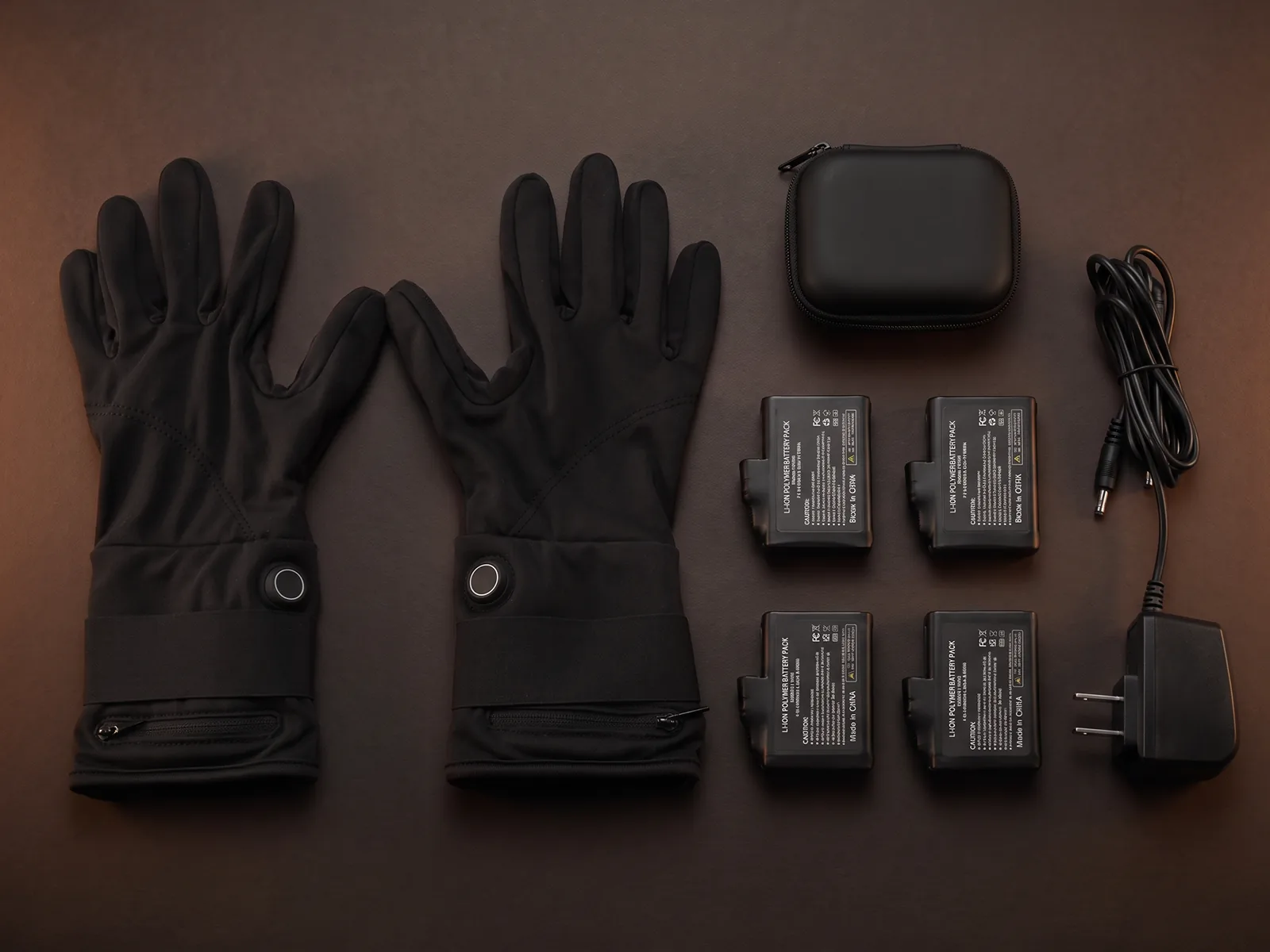
The pattern is familiar to anyone who has owned heated gloves. They work fine on the morning commute. By mid-morning one hand has gone quiet, and by lunch the other follows. The gloves end up in a drawer by February — not because they never worked, but because they never worked *all day*.
If that's where you are right now, here is the useful part: the gloves themselves are rarely the problem. In a heated glove, the part that warms up is a simple set of heating lines. The part that fails is almost always the part you can replace in five seconds — the battery.
The two-minute check order
Before you decide a glove is broken, run these checks in order. They take about two minutes and they settle almost every mid-day failure.
1. Swap the batteries between hands. Each glove runs on its own battery. If the cold glove warms up with the other hand's battery, the battery was drained — nothing is broken. If the same hand stays cold, move to step two. 2. Reseat the battery pod. A pod that has shifted in its strap can lose contact without looking wrong. Click it off, click it back on until it seats fully, and give the glove ten seconds. 3. Check the charger, not the battery. The classic failure isn't a dead battery — it's a battery that never charged. On a dual-head charger, the indicator light tells you whether a set actually finished charging; without it, you're trusting a plug that may have worked itself loose overnight. 4. Only now suspect the elements. If a known-charged, firmly seated battery produces nothing, the heating lines themselves are the suspect. That is a fault, not a quirk — tell whoever sold you the gloves.
Most "my heated gloves stopped working" stories end at step one or step three. That's worth knowing before you replace a pair that was never broken.
Why heated gloves quit early
The check order fixes the failure in front of you. The design question is why it keeps happening — and the answer is that most heated gloves were drawn up for a ski day, not a workday.
| Where they quit | What's behind it | How the liner answers it |
|---|---|---|
| Both batteries flat by mid-day | Most heated gloves ship with two batteries — enough for a few hours, then you're parked at a wall outlet | Four batteries in the box, two full pairs — a flat set swaps out in seconds |
| One glove dies before the other | Each hand drains its own battery; no spare means the weaker hand goes cold | The empty pair goes on the dual-head charger while you keep wearing the fresh one |
| Battery knocked loose at the desk | Wrist-strapped batteries sit exactly where a desk edge or chair arm presses all day | The pod rides the back of the hand, strap-secured, clear of the desk |
| Charge breaks never noticed | No indicator means a half-charged set looks like a dead glove | The charger's light says when a set is actually ready |
None of these are exotic failures. They're the ordinary friction of a product designed around a charger, worn by people who can't sit next to one.
Swap, don't wait
The routine the liner was built around is deliberately boring. Click a battery onto the back of each hand in the morning. When a set runs flat, click in the fresh pair and drop the empty one on the charger — you keep wearing the gloves while the spares recover. The charger's indicator light settles the only question worth asking: are they ready?
Heat level is the other lever. Three settings — 104°F, 122°F, 140°F — trade warmth against runtime, and the highest setting empties a battery fastest. On a day when peak heat isn't needed, dropping one level is the cheapest way to make a set last longer.
And if your day involves a keyboard, the gloves don't need to come off to type — that's a separate problem with its own write-up on typing in heated gloves. Pulling gloves off and on all day is its own way of losing heat; conductive thumb and index fingertips mean a text gets answered without any of it.
What about the wires?
Honest answer: heating lines can fail, usually after seasons of sharp creasing — a glove crumpled into a bag corner every night eventually pays for it. But they are the *last* thing in the chain to suspect, not the first. A battery is a consumable; a contact is a moving part; a heating line with no power going through it behaves exactly like a battery problem. That's why the swap test comes first: it tells you which part you're actually angry at.
Cold hands shouldn't come with a troubleshooting hobby. The whole point of shipping four batteries is that the failure mode with a fix — a flat set — never has to end your day.
See how the Heated Liner Gloves are built.
FAQ
Why does one heated glove stop heating while the other still works?
Each glove runs on its own battery. Swap the batteries between hands: if the cold glove warms up, the battery was drained — charge it. If the same hand stays cold, reseat the battery pod before assuming a fault.
How long does a heated glove battery last?
It depends on the heat level and the temperature around you, which is why runtime is being re-confirmed on production units before we publish a figure. What's fixed: four batteries ship in the box, so a drained set doesn't end your day.
Do heated gloves drain the battery faster on higher settings?
Yes. Heat levels trade warmth for runtime — the highest setting empties a battery fastest. Dropping one level when you don't need peak heat is the easiest way to stretch a set.
Why do heated batteries deliver less in the cold?
Batteries give up less power when they're cold — the same charge simply does less work. It's one more reason a spare set beats a charger: swap in a fresh pair instead of waiting for a cold battery to recover.