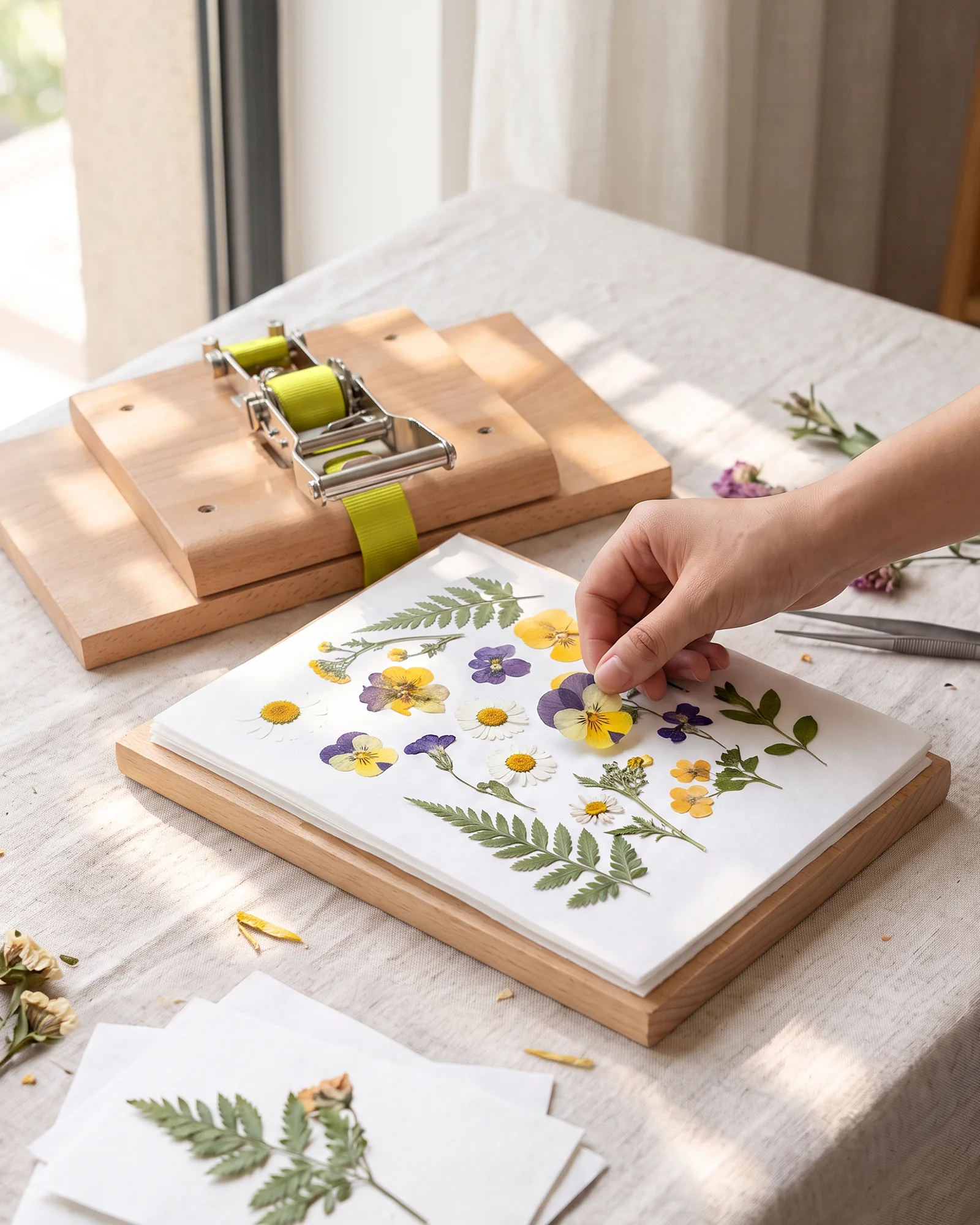
Ask how long flowers need in a press and you will hear everything from two days to a month. The honest answer is a range, because pressing time follows the flower, not the calendar. A fern and a rose do not dry at the same speed.
The good news: the ranges are narrower than most beginners expect, and there is one reliable way to tell when flowers are actually finished.
The short answer
| What you are pressing | Time in the press |
|---|---|
| Leaves and thin stems | 1–3 days |
| Flat, single-layer flowers | 3–6 days |
| Multi-layer flowers | 7–10 days |
Those ranges suit the flowers presses handle best: zinnias, delphiniums, pansies, violas, daisies, geraniums, cosmos, and most ferns. Thick blooms like lilies, orchids, and roses are a different project — the petals press beautifully once you trim them off the stem and lay them flat, but they hold much more water, so expect the long end of the range.
Why pressing time varies
Four things move the clock:
- Water content. Larger or wetter flowers simply take longer. A crisp cosmos petal dries in days; a thick rose petal takes its time.
- Thickness of the layer. Flowers of similar thickness should share a layer. Pair a flat viola with a fleshy geranium and one of them finishes late.
- How full the stack is. Six foam sheets and six blotting boards build proper layered stacks — but an overstuffed stack presses unevenly and dries unevenly too.
- Room conditions. The last step of pressing is to seal the bag and keep it somewhere cool and dry. A humid room slows everything down.
The touch test beats the calendar
A flower can look flat long before it is dry. Flattening happens in the first day or two; full drying takes the rest of the week. So judge by touch, not by sight.
Open a batch to check. Done petals feel papery and completely dry — cool, limp, or tacky petals need more time. If they are not ready, close the press, pull the strap tight again, and check again in two days.
That re-tightening matters more than most people realize. As flowers lose moisture they shrink, and the stack loosens with them. Flowers left in a loosened press dry in the wrong position and curl later. A few seconds of tightening at each check keeps the pressure honest.
What happens if you open the press too early
Nothing catastrophic — pressing is forgiving. The risks are curling, wrinkling, and slow browning where moisture lingers. If you peek at day two and the petals are still soft, you have lost nothing: close the press, re-tighten, and let the next few days finish the job. For flowers that never dry properly and start to smell or spot instead, that is mold — here is why dried flowers go moldy and how to stop it.
Can you leave flowers in too long?
Mostly, no. Once petals are fully dry, plant material stops changing much — a press held another week is harmless. The real failure mode is different: flowers left for weeks in a loosened stack dry loosely and warp. If that happens, press them again, snug and even, for a few more days.
The moment they pass the touch test, take them out. Pressed flowers pull moisture back out of the air, so storage matters as much as pressing: keep them airtight, away from light and damp, to prevent oxidation and mold.
Why the microwave is the wrong shortcut
Search long enough and you will find microwave pressing kits. A flower press is not one of them: it has metal parts and must stay out of the microwave. The blotting boards are the exception — they can be recharged on their own in a microwave or oven following the user guide, and never left heating unattended.
If you want faster results, load smarter instead: single layers, similar thickness per layer, small batches, and a cool, dry room.
A simple timeline to work from
| When | What to do |
|---|---|
| Day 0 | Pick flowers at their peak and press them the same day |
| Day 1–3 | Leaves finish; thicker flowers keep going |
| Day 3 | First check: open, touch, re-tighten |
| Day 3–6 | Flat, single-layer flowers finish |
| Day 7–10 | Multi-layer flowers finish |
The bottom line
Give flat flowers 3–6 days, thick multi-layer blooms 7–10, and trust your fingertips over the calendar — papery and completely dry means done. Tighten the stack every time you check, and move finished flowers into airtight, dark, dry storage.
If you are still choosing how to press, how a ratchet flower press works explains why even pressure matters as much as time. And if your goal is a longer-lasting display rather than flat specimens, the dried-flower shadow box guides cover that side of flower preservation.
See the Wisedry Ratchet Flower Press.
FAQ
Can I open a flower press to check on the flowers?
Yes. Open a batch to check: petals that feel papery and completely dry are done. If they still feel cool or limp, close the press, tighten it again, and give them more time.
Why are my pressed flowers still damp after a week?
Larger or wetter flowers simply take longer, and a humid room slows drying. Re-tighten the press as the stack compresses and keep it somewhere cool and dry.
How do I speed up flower pressing?
Press thin, similar-thickness flowers in single layers, keep batches small, and keep the press somewhere cool and dry. Never put the press itself in a microwave — it has metal parts.
How should I store flowers after pressing?
Keep pressed flowers airtight, away from light and damp, to prevent oxidation and mold. Stored that way they hold their color and shape for years.