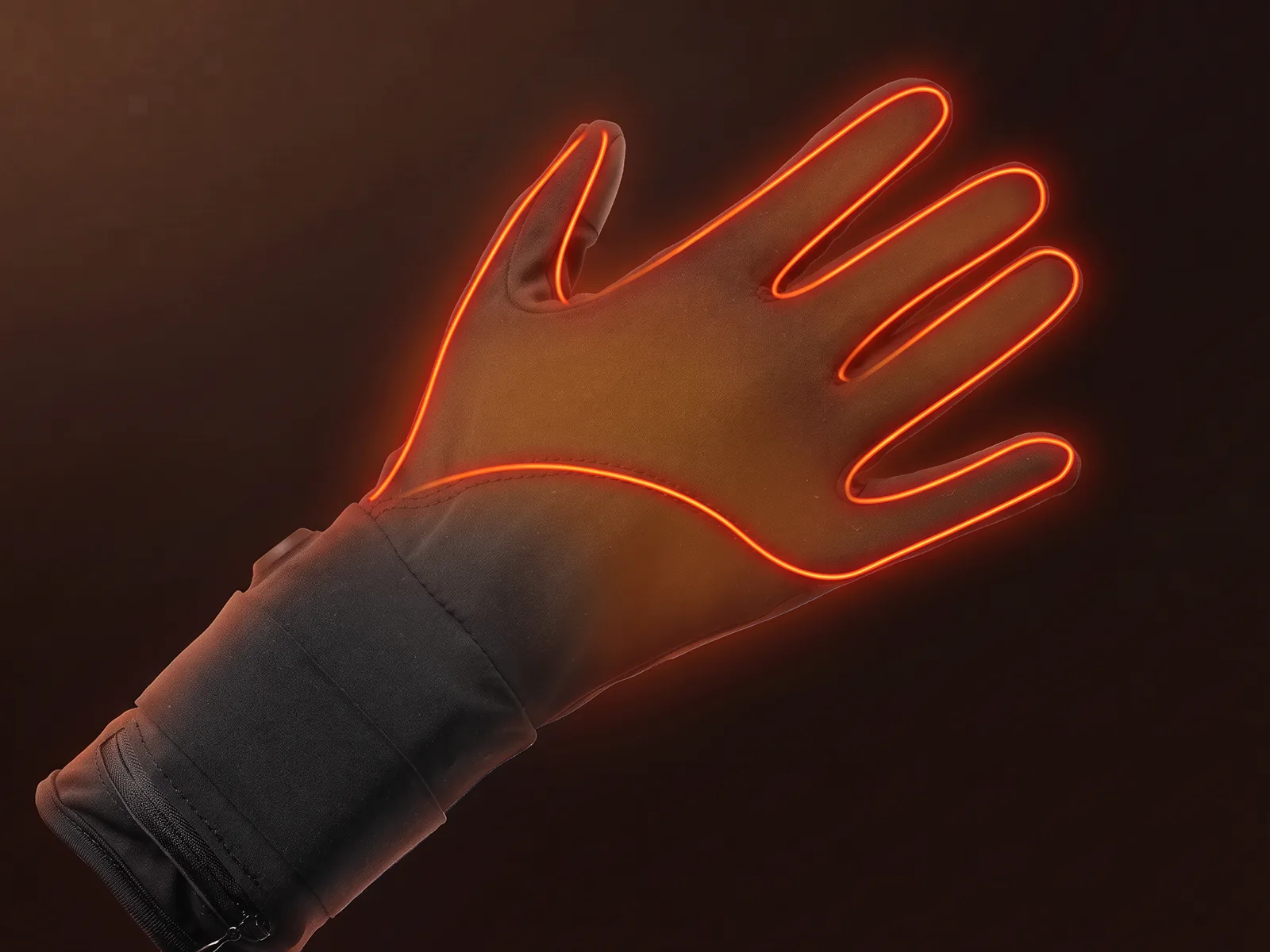
There is a specific kind of disappointment in buying the warmest gloves you can find, wearing them indoors all day, and still ending up with cold fingers by mid-morning. If that keeps happening to you, the gloves probably aren't broken and the store didn't lie to you. Something in the assumption was wrong — and it's worth spelling out, because it decides everything else you do about cold hands.
For some people this is an occasional nuisance on a walk. For others — including people living with Raynaud's — cold hands are an all-day, indoors, every-weekday reality, and "just wear warmer gloves" stops being advice and starts being an insult.
What a glove actually does
Start with the part nobody says out loud: a glove doesn't produce heat. It only slows heat down. The insulation in a glove — padding, fleece, trapped air — works by making it harder for the warmth your hands already generate to escape. That's the entire mechanism.
Which means insulation has a hidden prerequisite: your hands have to be making enough heat in the first place. If they are, a good glove holds it in and you stay comfortable. If they aren't, the best insulation in the world can only slow the cooling. Your fingers don't stay warm longer because the glove is warmer — they stay warm longer because the escape route is narrower. Eventually the arithmetic lands in the same place.
This is why the "thicker gloves" recommendation fails so reliably for cold-handed people. Thickness addresses the escape of heat, never the supply.
Why thicker usually makes it worse
The plot twists: for indoor, all-day wear, going thicker often leaves you colder by the end of the day than a thinner glove would. Not because thick gloves are bad — because of what thick fingers do to your behavior.
- You take them off. Padding that turns every finger into a mitten can't type, text, turn a page, or find keys in a bag. So the gloves come off for two minutes, your fingers dump whatever heat they had, and putting the gloves back on means re-warming from a worse position than where you started.
- Fit stops being right. A glove that's thick enough often runs loose where it matters. Compressed padding insulates poorly, and a loose cuff lets every hand movement pump warm air straight out.
- The on-off cycle compounds. Every removal is a fresh start from colder hands. By the third cycle you're chasing a deficit that started at nine in the morning.
None of these show up on a temperature rating. All of them decide whether your hands are actually warm at three in the afternoon.
The usual suspects, in order
Before blaming your circulation, run down the list. Most cold-hands-in-gloves complaints trace to one of these five.
| Suspect | What's actually happening | Quick fix |
|---|---|---|
| Gloves don't make heat | Insulation only traps what your hands produce — little production, little to trap | Add active heat instead of relying on trapped warmth |
| On-off cycle | Gloves come off for phones, keyboards, small tasks; fingers re-cool each time | Keep gloves on: touchscreen fingertips and enough dexterity to leave them be |
| Loose or wrong fit | Warm air escapes at the cuff; compressed insulation insulates poorly | Size properly — for our liner, that's palm circumference and middle-finger length, XS through L |
| Heat never reaches fingertips | Padding is thickest on the back of the hand; fingertips sit at the cold end | Check where warmth actually arrives, not just how thick the glove is |
| Heat only trapped, never controlled | No way to add warmth when the room, not the weather, is the problem | Active heat with adjustable levels |
What active heat changes
Active heat breaks the trap-only model: instead of slowing heat down, the glove adds heat. That's the entire category of heated gloves — and once you're in it, the details that matter are different from ordinary winter gloves, and most of them never make it onto the box.
- Where the heat runs. In many heated gloves the elements warm the backs of the fingers — the same place ordinary padding already concentrates. Fingertips stay at the cold end. In our liner, the heating lines run across the back of the hand and up both sides of every finger, because the tips are where cold hands feel it first.
- How fast it arrives. Waiting thirty minutes for warmth defeats the purpose. Ours is perceptible within about ten seconds of switching on — which sounds like marketing until you've lived with a glove that needs a commute to warm up.
- Whether you can turn it down, not just up. Rooms differ. Three levels — 104°F, 122°F, 140°F — mean you match warmth to the room instead of sweating through the only setting, and lower settings stretch each battery further.
- What happens when the battery ends. This is where heated gloves earn or lose their keep. A design with two batteries parks you at a wall outlet; our box ships four batteries in two pairs, so a flat set swaps out in seconds and the empty pair goes on the dual-head charger. (The full swap routine — and why heated gloves usually quit mid-day — has its own write-up on why heated gloves stop working.)
- Whether you keep them on. Thin enough to keep working in, with conductive thumb and index fingertips, means a text gets answered and a keyboard keeps clattering without the gloves coming off. The dexterity side of that trade is covered in typing in heated gloves.
That last point matters more than any spec. The warmest glove is the one still on your hands at the end of the day — and the whole reason our liner exists is that "warm" and "usable" kept being sold as either/or.
Wearing them through a real day
The routine we designed around is deliberately boring. In the morning, click a battery onto the back of each hand — the pod rides the back of the hand, clear of the desk edge, where a wrist strap would press all day. Wear the liner like an ordinary glove. Press one button, pick a level; the indicator light fades after three seconds, so nothing on the glove asks for a second look in a meeting. Indoors, that's the whole day. Outdoors in real cold, the liner layers under a shell glove — its job is the heat; the shell's job is the wind.
One boundary, stated as plainly as it is on the product page: these are comfort products, not medical devices, and nothing here replaces advice from your doctor.
If your hands have been losing the insulation argument for years, the useful reframe is this: stop asking how to trap more heat, and start asking how to add it — at the fingertips, at a level you choose, without ever taking the gloves off.
See how the Heated Liner Gloves are built.
FAQ
Why do my fingers get cold even in thick gloves?
Insulation slows heat loss; it doesn't add heat. If your hands aren't producing much warmth to trap, the padding only delays the cold — and fingertips, the farthest points from where your body sends warmth, feel it first.
Do heated gloves actually keep fingers warm?
It depends on where the heating elements run. Many gloves warm only the backs of the fingers. Our liner runs heating lines along both sides of every finger, so heat reaches the tips — where cold shows up first.
What heat setting should I use on heated gloves?
Start low and adjust. Three levels — 104°F, 122°F, 140°F — let you match warmth to the room. Higher settings drain a battery faster, so the lowest comfortable level also lasts longest.
Can heated gloves be worn under other gloves?
A liner-style heated glove can. Ours is built thin enough to layer under a shell outdoors, and indoors it reads as an ordinary glove on its own.
Do I have to take heated gloves off to use my phone?
Not if the thumb and index fingertips are conductive — the two fingers you text with. Keeping the gloves on keeps the warmth intact instead of starting over.