One decision, made twice a day
Strip away the apps and the alerts, and an automatic coop door does a single job: it opens once in the morning and locks once in the evening. Everything about how well it does that job flows from one question — where does the decision come from?
There are only three answers on the market. The door can watch the light, run on a clock, or work from your location's actual sun times. The three look interchangeable on a product listing, and they are not. Each one fails in a different, predictable way, and the failure usually shows up at the worst possible moment: the flock locked out at dusk, or the door swinging open into a dark yard.
The light sensor: simple, cheap, and easily fooled
The oldest trigger is a photoresistor — a small eye that opens the door when it detects daylight and closes it when darkness falls. There's real appeal here: no setup, no schedule to program, and it tracks the seasons automatically, because winter mornings really are darker than summer ones.
The problem is that darkness is the only thing it knows. A car's headlights sweeping the yard at 2 a.m. can read as dawn. A porch light across the driveway, a security floodlight, even the glow off fresh snow can hold the sensor in "daytime" long past dark. And on a heavily overcast morning, the world stays dim enough that some sensors sleep in — which means the flock stands inside a closed coop waiting, on the one morning you overslept.
Placement becomes a workaround you manage forever: the sensor needs to see the sky, but not your porch light, not the neighbor's floodlight, not the reflective side of a snow-covered run. In a backyard — which is to say, a place full of artificial light — that's a fragile ask.
The fixed timer: predictable, and blind to the seasons
The second option is a clock. You set 7:00 a.m. and 6:00 p.m., the door fires at those times every day, and nothing in the environment can fool it.
What a timer can't do is follow the seasons. Across most of North America and Europe, sunrise and sunset swing by hours between summer and winter. The times you set in June are wrong in October and badly wrong in December. So the honest timer owner reprograms the door a few times a year — which quietly reintroduces exactly the chore the door was bought to remove. The dishonest alternative is worse: set it once and let December open the door hours before sunrise, into darkness, with the flock still roosting and predators still out.
A timer also can't express the two rules that actually matter to a flock: open a little *after* sunrise, close a little *before* sunset. Chickens come out with real daylight, and they head in at dusk. A fixed clock can only approximate both — and every approximation is a moment the door and the flock disagree.
Sun times: the trigger that knows where you are
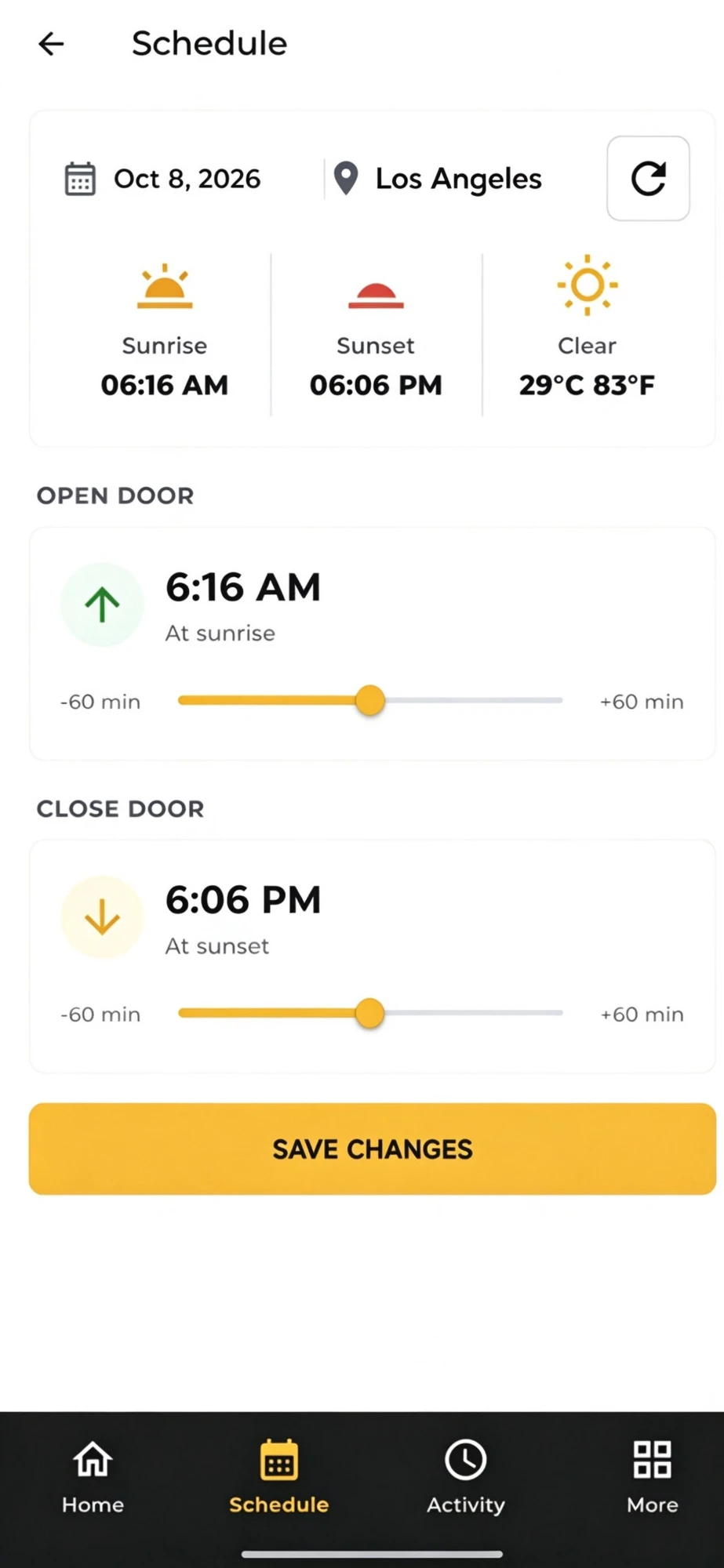
The third option answers the season problem directly: the door calculates your location's real sunrise and sunset, then opens a set number of minutes after the first and closes a set number before the second. The schedule is built from astronomy, not from a photocell or a fixed clock, so no porch light can fool it and no season can drift away from it.
On our own LARKBIRD Smart Coop Door, the schedule works exactly this way: sun times refresh automatically for your location, and you shift each side of the day with an offset — up to 60 minutes after sunrise for the open, up to 60 minutes before sunset for the close, or anything in between. Set it once and short winter days and long summer evenings take care of themselves. And if a sync is ever missed, the door re-checks and catches up on its own rather than sitting stuck until you notice.
This is the mechanism behind the winter question too: a door that knows the real sunset will lock the flock in before dark on the year's shortest day just as reliably as on the longest.
The three triggers, side by side
| Light sensor | Fixed clock timer | Sun-times schedule | |
|---|---|---|---|
| Decides by | How dark it is right now | A time you once set | Your location's real sunrise and sunset |
| Typical failure | Opens into headlights or a porch light; sleeps in on dark mornings | Drifts hours away from the seasons | A missed sync — if the door doesn't self-correct |
| Seasonal maintenance | None, but misfires all year | Re-edit through the year or accept drift | None — sun times refresh automatically |
| "Open after sunrise, close before sunset" | Can't aim for it | Only approximately | Exactly, with offsets you choose |
| Fooled by the environment | Yes — any light source | No | No |
Whatever the trigger, the close has to report failure
Choosing a trigger doesn't finish the job, because a schedule is a claim, and the door needs a way to tell you when reality doesn't match it. If something blocks the closing door, what happens next separates a door you trust from a door you babysit. Ours backs off and retries twice; the third attempt pushes full power for a few seconds; if it's still stuck, it stops and sends an alert to your phone instead of failing silently. A low-battery warning arrives at 30% with days of margin remaining, every door move is written to an auditable log, and self-checks run every two hours. The details are on the product page.
That pairing — a schedule that can't be fooled, plus hardware that speaks up when a move doesn't complete — is what makes the door worth automating in the first place. A timer that fires into the dark and a sensor that sleeps past dawn are both, in the end, doors that need you standing next to them anyway.
What to check before you buy
Ask any automatic door these four questions:
- Does it use my actual sun times, or a light level? A photocell will meet your porch light eventually.
- Can I set the offsets? Opening after sunrise and closing before sunset is the whole point — the margin should be yours to choose.
- Does it catch itself up after a missed sync? A schedule that waits for you to notice isn't automatic.
- What happens when a close stalls? Back off, retry, alert — never silence.
Set once, honest at both ends of the day, and loud when something goes wrong: that's the standard. The trigger is where it starts.
*Related: do automatic coop doors need Wi-Fi? · mains, battery, or solar power compared · why chickens need a consistent door schedule*
FAQ
Do automatic coop doors work on cloudy or overcast days?
A light-sensor door can struggle, because a heavily overcast morning can look like night to a photoresistor. A door that runs on your location's actual sun times doesn't care about weather at all — sunrise and sunset happen on schedule whether the sky is clear or grey. That's a different question from whether the battery stays charged on cloudy days, which is about the power source, not the trigger.
What time should an automatic chicken coop door open?
After sunrise, not before. Hens wait for real daylight before coming out, so opening in pre-dawn darkness gains you nothing and hands predators extra active hours with the door open. A sun-times door with an offset lets you open a set number of minutes after sunrise — enough margin for the sky to actually be light.
What time should the door close in the evening?
Before sunset, by a margin you choose. Chickens instinctively head inside at dusk, so closing a little before sundown gets the flock in and locked before true dark, when predators start working. With an adjustable offset you can close up to an hour before sunset — or any margin in between.
Do I have to change the door's schedule when the seasons change?
Not if the door tracks your location's real sun times — those shift automatically as the days lengthen and shorten, so the schedule never needs a seasonal edit. If your door runs on a fixed clock timer, then yes: the sunrise you set in June will be wrong by hours in December, and keeping it honest means reprogramming it through the year.