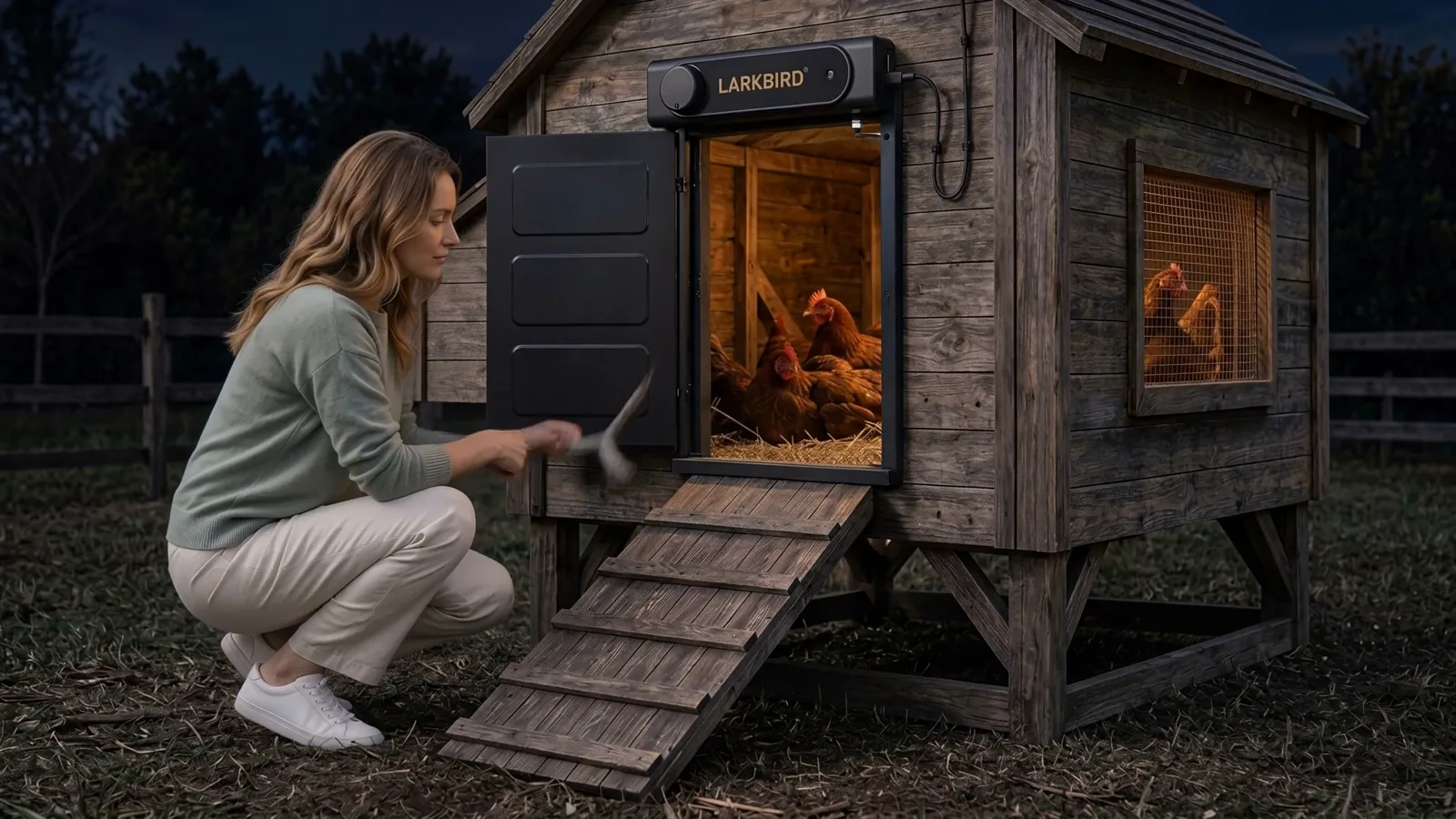
The question usually shows up two weeks before a trip. The flock is fine, the feeders are filled — and then someone says it out loud: who is standing at the coop at dusk on Tuesday? And Thursday? A week away means seven sunsets in a row when the pop door has to close with nobody watching, and seven dawns when it has to open again. Manual latches make that a scheduling problem between you and your neighbors. It's the reason many people start looking at automatic doors in the first place.
But "automatic" is a promise with fine print. A door that can't be trusted alone is just a latch that moves sometimes. So the honest version of the question is: what does a coop door actually have to get right to cover a week without you?
Four things have to work at once
Run through the failure modes of a week away and four jobs keep coming up:
- The schedule has to open and close at the right time every day, without anyone reprogramming it as the days shorten or the weather changes.
- The power has to outlast the trip, including grey days when the solar panel sees little sun.
- The failures — a jammed track, a forced door, a draining battery — have to reach you, not wait for your return.
- You need a way to check the door from wherever you actually are.
A door that does one or two of these well can still leave you wondering on a dark evening. The design question is what happens at the worst moment of each job.
The schedule must follow the sun, not a clock
Fixed timers are the quiet trap of a week away. You set them before leaving, and the season keeps moving underneath them — dusk in November is not dusk in September, and a door on a springtime clock is closing at the wrong hour by autumn. Light sensors have their own trouble: a porch light or a bright moon can convince them it's still daytime.
The sturdier approach is the one this door uses: real sun times computed from your location, refreshed automatically, with your own offsets layered on. Open up to 60 minutes after sunrise, close up to 60 minutes before sunset — set once, no seasonal edits, which is exactly what you want in a week when you can't touch it. And if a sync gets missed while you're gone, the door re-checks and catches up on its own rather than holding a wrong schedule until you're back to notice. The deeper reason this matters — flock routine depends on a consistent rhythm, not a clock time — is in our piece on why chickens need a consistent door schedule.
The battery has to outlast the grey days
A week is short compared to what the split design buys you. Outdoors there is just a lock, a receiver and a 5,000 mAh battery — no Wi-Fi radio, no screen, nothing hungry — so the door barely spends. In bench testing it ran 15+ days on the battery alone, cycling daily, before any solar help.
The published field log makes the rain case concrete. Across August 1–5, with light rain and overcast skies, the solar panel alone pulled the battery from 0% to 100%. Then, with the panel disconnected, the door ran from August 6 to August 23 — 18 days — before the battery emptied, still cycling daily through storms and grey stretches. One endurance run went 204 straight cycles with zero failures.
For a trip, the details that matter more than capacity: the low-battery warning fires at 30%, deliberately raised so it arrives with days of runtime left rather than minutes. And if a long grey stretch wins anyway, the Type-C port turns the fix into a five-minute indoor charge — like topping up a phone — before you go or when you're back.
Failures have to reach you, not wait
This is the part that decides whether you sleep on vacation. Every automatic door eventually meets a stuck moment; the difference is what happens next.
| While you're away | A lesser door | What this one does |
|---|---|---|
| Something blocks the door at dusk | Grinds, hangs half-open, or gives up silently | Backs off and retries twice; the third attempt pushes full power for five seconds; still stuck, it stops and alerts |
| Something pulls the door open at night | Nobody knows until morning | Forced-open alert, with the event in the log |
| Battery drifts down through a grey week | Dead door, no warning | Warning at 30% with days of margin; Type-C top-up when you're back |
| A sync or link is missed mid-week | Schedule frozen until someone notices | Door re-checks and catches up on its own; last 50 events stay on the unit, marked done or failed |
| Deep winter freeze on the frame | Motor fights until it burns | Checks its position, breaks light ice with extra force — severe icing stops it safely with an alert instead |
The honest limit is on that last row: severe icing can still stop the door. The design choice is that it tells you — every two hours the door also verifies its motor and its link and reports drift, so an open coop at midnight is a notification, not a discovery. What winter trips actually demand, and where the real limits sit, is covered in will an automatic coop door survive winter?
The check from wherever you are
Half of vacation peace is just being able to look. Open the app and the door's state, battery and recent moves are there; every action comes back confirmed. That reach is why the system is split in two: the door talks to an indoor gateway over a 915 MHz link — a sub-GHz band built for distance, field-tested at 250 m with houses, walls and trees in the way — and the gateway, on wall power indoors, is what your phone reaches over broadband. The pairing is point-to-point: the door answers its own gateway and ignores every other radio on the band.
There's a quiet benefit in the split for travel weeks: the hop that matters for opening and closing never touches the internet. If your broadband blips while you're away, the schedule keeps firing and the log keeps writing on the unit itself; you're reading it again the moment the connection returns. What each connectivity design can and can't do during an outage is laid out in do automatic coop doors need Wi-Fi?
Where a sitter still wins
One boundary worth stating plainly: the door covers the door. Feed, water, egg collection and someone actually looking at the birds still need hands if you're gone more than a couple of days. What the automation removes is the twice-daily lock-in chore — the thing that turns a weekend trip into a negotiation. With the schedule, power and alerts handling the doorway, the favor you ask a neighbor shrinks from "come at dawn and dusk, every day" to "drop by once a day and top up the water."
Before you leave: five minutes at the coop
- Check the battery percentage in the app; if it's below 30%, give the unit a Type-C top-up while you pack.
- Walk the door track once and clear the straw, feathers and cobwebs a jam alert would rather not meet.
- Confirm the schedule is on sun times with your usual offsets, not a countdown someone set last month.
- Glance at the recent-moves log — you want to leave a door that's been opening and closing cleanly, not one with a failed event from last night.
- Look at the sky, not the battery spec: a sunny forecast means the panel is covering the door all week.
Do those five things and the door's job list for the week is short: open with the sun, close before dusk, spend almost nothing, and speak up if anything is off. That's a job list a well-built door can finish without you.
See the LARKBIRD Smart Coop Door — two units, no outlets, no Wi-Fi at the coop.
FAQ
How long can an automatic coop door run unattended?
Longer than most trips. In bench testing this door ran 15+ days on its 5,000 mAh battery alone with the door cycling daily, and in normal sun the solar panel refills faster than the door drains. A 30% low-battery warning arrives with days of margin, and a Type-C port handles a top-up indoors when you're back.
What happens if the door jams while I'm not there?
It doesn't fail silently. The door backs off and retries twice; the third attempt pushes full power for five seconds; if it's still stuck, it stops for good and your phone gets the alert. The last 50 door events stay on the unit, each marked done or failed.
Can I check the coop door from my phone while traveling?
That's what the indoor gateway is for. The door links to it over a 915 MHz radio — field-tested at 250 m with houses, walls and trees in between — and your phone reaches the gateway over your broadband. The app shows the door's state, its battery and its recent moves.
Does an automatic door remove the need for a chicken sitter?
For the door, yes. For the flock, not entirely: feed, water, egg collection and a health once-over still need hands on longer trips. What the door removes is the twice-daily lock-in chore that pins you — or a favor — to the coop at dawn and dusk.