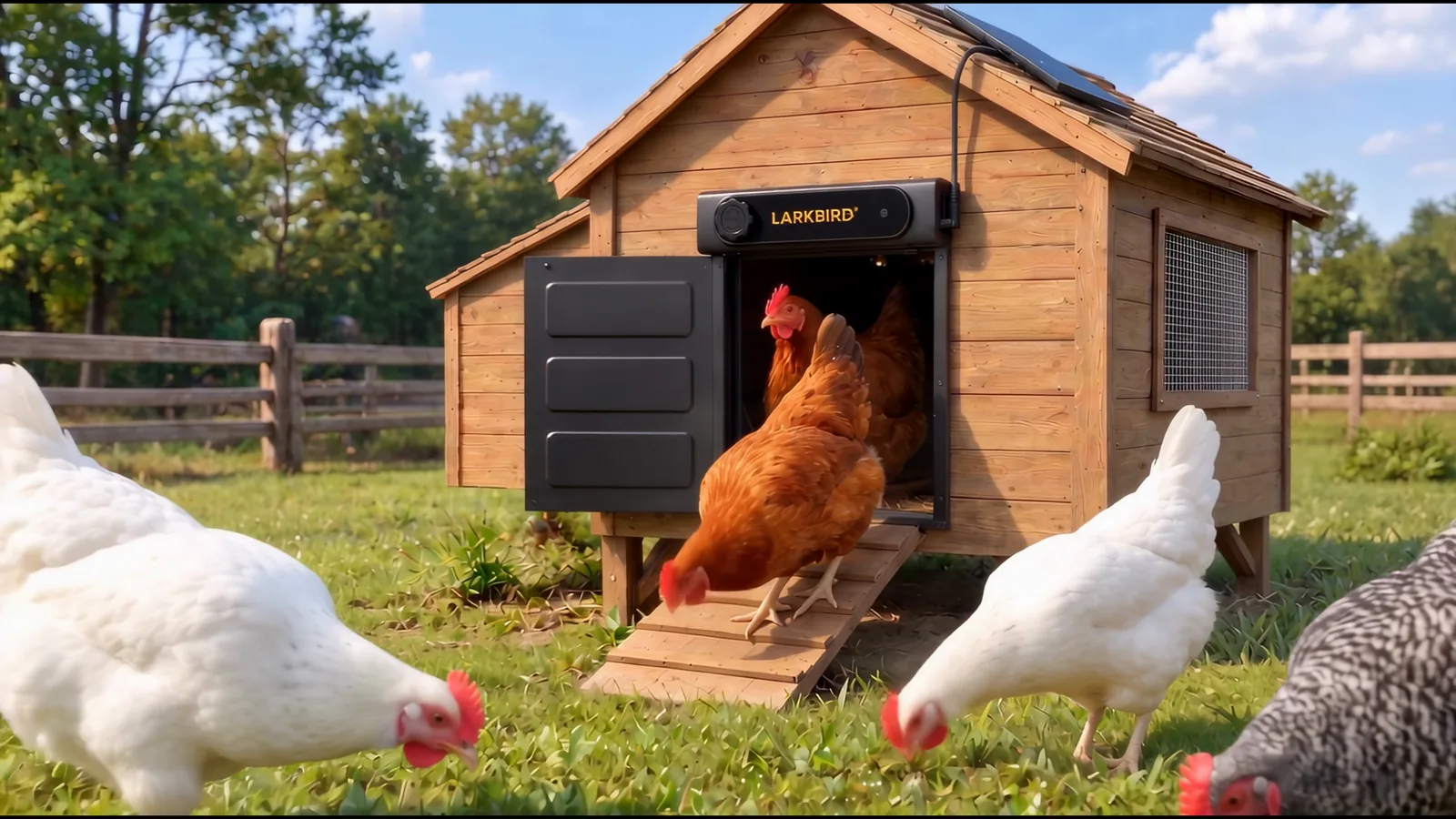
Every automatic coop door owner eventually meets the same thought. You're out for the evening, and somewhere between the restaurant and the drive home it arrives: *did the door actually close?* The hens went in at dusk, the mechanism did its thing — probably — and now you're deciding whether to drive back to a coop you can't see.
That worry is legitimate, because a coop door failure isn't symmetric. A door that fails open leaves the flock exposed all night. A door that fails closed keeps birds locked out. Both matter, and neither is visible from your kitchen. So the real question isn't "will my door ever fail" — anything with a motor and a battery eventually has a bad night. It's what the door does in the moment of failure, and whether you find out.
The failure modes that actually matter
Strip it down and an automatic door can let a flock down in a handful of ways. What separates a considered design from a bare motor-and-timer kit is what happens in each row of this table:
| Failure | What a bare door does | What a considered design does |
|---|---|---|
| Something blocks the door | Grinds against it, stalls, or burns the motor out silently | Backs off, retries, then stops for good and alerts your phone |
| Battery runs down | Door dies with no warning, mid-cycle or overnight | Warns early — at 30% with days of runtime left — plus backup charging |
| Schedule slips | Fixed clock drifts with the seasons, opens at the wrong time | Sun-time schedule refreshes itself; a missed sync re-checks and catches up |
| Door forced open | Nobody knows until morning | Immediate alert, with the event logged on the unit |
| Link or electronics drift | Silent failure, discovered by accident | Periodic self-checks of motor and link, reported before they matter |
| "Did it actually close?" | Unanswerable from a distance | Event log on the unit — last 50 door events, each marked done or failed |
The right-hand column isn't hypothetical technology. It's the standard a door should be judged against, and it's the standard we built our two-unit coop door around — the details below are how it behaves, not marketing.
When something blocks the door
The worst behavior a door can have is persistence. A motor that keeps pushing into an obstruction risks whatever is in the way — a bird, a stick, a rake handle someone left against the ramp — and destroys itself in the process.
The staged response is the fix. First contact with resistance: the door backs off and retries. A second block: it backs off again. A third attempt gets a short burst of full power — enough to push through bedding or a light obstruction a determined door genuinely should move — and if it *still* can't close, it stops for good and your phone gets the alert. Not stuck in a loop all night. Not quietly broken. Stopped, logged, and reported.
That behavior also answers the safety question most people ask before they ask the failure question: a door that gives up instead of grinding is a door that won't hurt what's standing in it. How automatic doors behave around chickens covers that side in full.
When power runs low
A battery-powered door dying silently is the failure you can't see coming — which is exactly why the warning has to come early. Our door unit raises a low-battery alert at 30%, deliberately timed to land while there are still days of runtime left, not minutes. That margin is the whole point: an alert at 5% is a notification of failure; an alert at 30% is time to act.
The margin is honest because the door barely spends. The outdoor unit carries just a lock and a receiver — the hungry electronics live indoors on wall power — so the 5,000 mAh battery ran 15+ days on its own in bench testing before any solar help. In normal sun the panel refills faster than the door drains. And if a run of gray days still drags the battery down, there's a wired Type-C backup charge as the last resort. How long the battery actually lasts breaks the numbers down further.
When the schedule slips
Fixed-clock doors fail slowly and politely: the seasons shift, the clock doesn't, and by late autumn the door is opening well after sunrise and closing long before the hens are in. A sun-based schedule avoids the drift — open times calculated from your location's actual sunrises and sunsets, adjustable by offset, never needing a seasonal edit.
The subtler failure is the sync itself: what if the schedule update doesn't arrive? The door re-checks and catches up on its own, rather than sitting wrong until you notice. Why chickens need a consistent door schedule explains why that consistency is worth engineering for in the first place.
The log: separating electronics from reality
Here's the honest part. Alerts and self-checks cover the *electronic* failure modes — motor, battery, schedule, link. They cannot cover physics. A ramp blocked by a snow drift, a latch fouled by bedding, a bird standing in the doorway at closing time: the door will behave correctly — retry, give up, alert — but no amount of circuitry closes a door something is physically holding open.
That's what the event log is for. The unit keeps the last 50 door events, each marked done or failed, ready in the app. When the alert says the third close attempt failed, the log tells you *that*; your monthly walk-around tells you *why* — and if the reason turns out to be birds dawdling outside rather than a mechanism problem, that's a training issue, not a door issue.
So back to the drive home and that 9 p.m. thought. The difference between the two kinds of door owners isn't luck. One opens the app, reads that the door closed at sunset and the battery is at 71%. The other drives back to check. The door didn't make the second person's evening worse — the missing information did.
FAQ
What should an automatic coop door do when something blocks it?
Not force through it. A safe design backs off immediately, retries a couple of times, and if the door still can't move it stops on its own and sends an alert to your phone. A motor that keeps pushing against an obstruction is a hazard to whatever is in the way and a way to burn out the motor at the same time.
How do I know if my automatic coop door didn't close?
Through two layers: a real-time alert the moment something is off, and an event log you can read afterward. The unit itself should keep a history of recent door events, each marked done or failed, so the question changes from 'did it close last night?' to 'here is the record of what it did.'
What happens if the battery dies while I'm away?
With a decent power design it shouldn't get that far without warning: a low-battery alert that fires while there are still days of runtime left, solar topping the battery up in normal sun, and a wired backup charging option. A door that goes silent at 5% with no warning is the design to avoid.
Can the open/close schedule fail silently?
A schedule based on your location's actual sun times should refresh itself and re-check after a missed sync — the door catches up on its own rather than sitting stuck until you happen to notice. Fixed-clock schedules are the ones that drift out of true as the seasons change.
What should I still check by hand?
The physical side. A door can log every electronic event and still be defeated by a ramp someone leaned a shovel against, a latch fouled by bedding, or a bird standing in the doorway. Electronics answer 'did the door command run'; a monthly walk-around answers 'is anything in the door's path that shouldn't be.'