Young birds and automatic doors meet at an awkward moment. The chicks are finally ready to live outside, the flock is settling into a dusk routine — and the one thing standing between the new birds and the roost is a door that opens and closes on its own schedule. So the question "when can young chickens use an automatic coop door?" is really two questions wearing one coat, and mixing them up is how integration weeks go wrong.
The first gate is feathers, not the door
The age part of the question has almost nothing to do with automation. Chicks leave the brooder when they're fully feathered — the downy fluff replaced by real plumage that holds body heat in. That commonly lands around 4 to 6 weeks of age, but the honest measure is the feathers, and the second honest measure is your local nights: the same 5-week-old bird faces a different night in Minnesota than in Georgia.
None of that changes with an automatic door. The door doesn't warm the coop, and it doesn't care how old anyone is. So gate one stays a plain husbandry decision: fully feathered, weather sane, and ideally past the fragile stage before any bird spends its first night out. What the door changes is gate two.
The second gate: what the door asks of a small bird
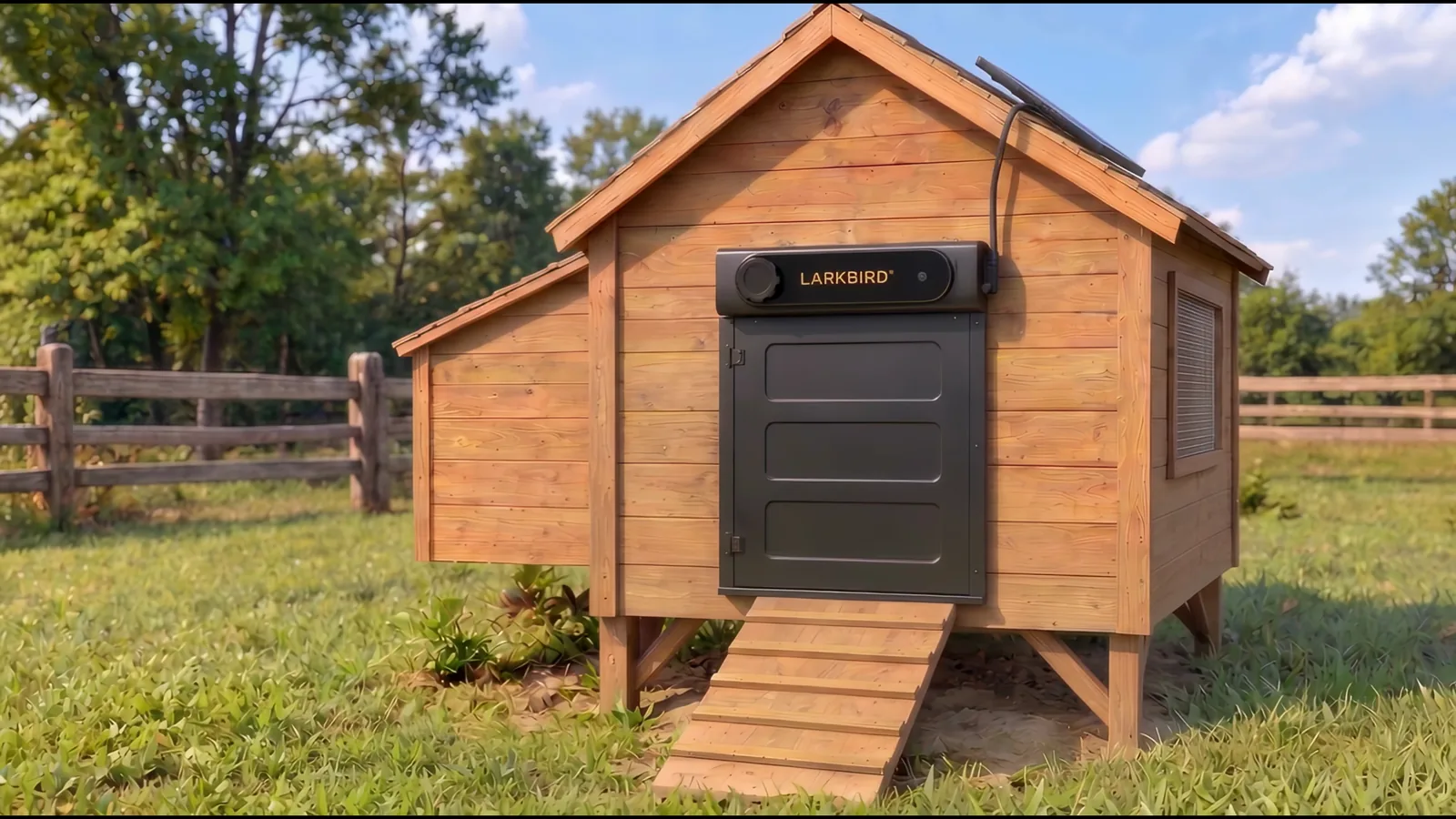
Once young birds are living with the flock, every member of that flock has to use the same doorway. Here the relevant numbers are concrete. Our pop door opening is 8.5″ × 11.4″ (21.6 × 29 cm) — sized to pass a full-grown hen comfortably. Any bird big enough to hold its own in a mixed flock fits through it. Bantams pass it easily. The doorway isn't the filter.
The filter is habit. An adult hen doesn't think about the pop door; she hits it at dusk on autopilot because she's done it five hundred times. A pullet on her first nights outside hasn't built that loop yet. She'll follow the flock through at dusk if the flock is moving — which is exactly why introductions work better with the whole flock than with a lone bird — but until the habit sets, she's the one dawdling near the doorway when it starts to move.
That's the scenario a well-built automatic door has to handle, and it's worth knowing exactly how yours behaves. If something blocks the door, ours backs off and retries twice; the third attempt pushes full power for five seconds; if it's still stuck, it stops for good and sends an alert to your phone. There's no phase where the door grinds down against whatever is in the way. A bird that lingers in the doorway buys itself space and you buy yourself a notification. The movement itself is quick — across a 204-cycle endurance run, moves averaged 0.25 seconds, and the slowest single move took 5.5 seconds — but the safety story isn't "it's too fast to hit you." It's that the door yields first and reports after.
(The deeper mechanics of obstruction-safe design — and the dusk habits that keep birds out of the doorway in the first place — are in will an automatic coop door hurt my chicken.)
The integration weeks are the real training program
So the answer to "when" is: young birds start using the door when they live in the coop — and the door's role during those first weeks is support act, not headliner. What the integration period actually asks of you:
| Stage | The birds | The door's job | What you watch |
|---|---|---|---|
| Brooder weeks | Chicks indoors, no coop access | Runs normally for the existing flock | Nothing new |
| Moving out | Fully feathered pullets join the coop | Schedule unchanged; young birds follow the flock through at dusk | Everyone using the doorway, not hovering near it |
| Integration | Flock order settling, dusk habits forming | Close offset shifted earlier, up to 60 minutes before sunset, so the doorway shuts while everyone's in and habits are still forming | The evening close lands on time, every evening |
| Full routine | One flock, one dusk loop | Offsets back to your preferred setting | Low battery, forced-open alerts — the boring stuff |
The offset control is the piece people underestimate. Because the schedule follows your location's actual sun times — opening after sunrise, closing before sunset, each adjustable up to 60 minutes — you can pull dusk's lock-in earlier for a few weeks while the young birds learn the routine, then relax it back. The schedule never needs seasonal edits either way; sun times refresh on their own.
And because a door you can't see is a door you have to trust, the other quiet helper is the log. Our unit keeps the last 50 door events, each marked done or failed, with a forced-open alert if anything pulls the door from outside and self-checks on the motor and link every two hours. During integration, that log is how you confirm the boring claim — the door closed on time at dusk, all week — without standing in the yard to watch it.
What the door will not do for you
Honest limits, because this is where marketing gets people into trouble. An automatic door does not count chickens. It knows the door opened and closed, whether the move succeeded, and whether something interfered — not whether seven birds are inside and an eighth is still on the ramp. If a pullet refuses to go in at dusk, the door will close on schedule and the problem will be exactly where it would be with a manual door: a bird that won't roost inside, which has its own causes and fixes (why won't my chickens go in at night). Treat the door's report as one fact — the doorway worked — not as a headcount.
Nor does the automation replace the integration work. The flock teaches the dusk habit; the offsets give you a safer margin while that lesson lands; the log proves the schedule held. None of it substitutes for watching new birds for those first evenings, and if you're planning to be away entirely, that's a different scenario with its own checklist (can you leave chickens alone for a week).
The short version: feathers decide when young birds move out, size decides whether they fit through the door, and habit decides when they own the doorway. The door's job is to be gentle with the bird who's still learning and loud about anything that goes wrong — and if it does that, the integration weeks take care of themselves.
See the Smart Coop Door — the two-unit system that runs the dusk routine and reports every move.
FAQ
What age can young chickens sleep outside overnight?
The usual threshold is feathers, not a fixed week count. Once chicks are fully feathered — commonly around 4–6 weeks, depending on breed and your local nights — they no longer need brooder warmth for everyday cold. Cold snaps and damp nights still deserve a look at the whole flock before you commit.
Will an automatic coop door close on a small chicken?
On a door built with obstruction behavior, the sequence when something blocks the way is: back off and retry twice, then one attempt at full power, then stop for good and alert your phone. The bird gets space, not a squeeze — and you get told instead of left guessing.
Can bantams use an automatic coop door?
Yes if the opening fits them. Ours is 8.5″ × 11.4″ (21.6 × 29 cm) — sized for a full-grown hen, so a bantam passes it comfortably. The habit question matters more than the size question for small birds: they need to treat the doorway as the way home at dusk, same as everyone else.
How do I introduce young chickens to an automatic coop door?
Let the flock do the teaching. Add pullets during the integration weeks, keep them close to the coop so they learn where home is, and shift the close time earlier (up to 60 minutes before sunset) while dusk habits are still forming. The event log tells you the door itself did its job each evening.
Does an automatic coop door know if a bird didn't make it in?
No — and any product claiming to count chickens should be read twice. A door tracks door events: opened, closed, done, failed. It confirms the doorway worked, not that every bird is inside. For a bird that won't go in, that's a flock-behavior problem, not a door problem.